
CCABA - Advanced Broadband Communications Center
CCABA Logo
Imagen
CCABA Image 1
1
Imagen
CCABA Image 2
2
Pic legend 1: CCABA Image 1
Pic legend 2: CCABA Image 2

General information

Universitat Politècnica de Catalunya

Description

The Centre de Comunicacions Avançades de Banda Ampla (CCABA) is the Universitat Politècnica de Catalunya (UPC)’s reference center for research and innovation in 5G and Beyond communication systems. Its activities were launched in January 1994 with the goal of integrating several UPC research groups working in the field of broadband communications.

CCABA’s areas of interest cover a broad range of technologies related to communications systems, including transmission technologies, cable networks, fiber optics and radio support, switching and interconnectivity, telecommunications network management, as well as protocols and services.

In recent years, the center has incorporated new emerging technologies developed under the concept of Next Generation of Communications Networks and Services (NGNS), such as 5G and beyond, Internet of Things (IoT), virtualization of networks and services, artificial intelligence, augmented reality, machine learning, and smart cities.

Summary of Research Services

The evolution of Next Generation of Communications Networks and Services has progressively influenced the structure and research lines of CCABA, shifting its focus toward the design, integration, and validation of Artificial Intelligence-based platforms for end-to-end 5G and Beyond smart networks and services.

Within this context, CCABA leads the participation of UPC in the 5G-BCN Consortium and is currently involved in several research projects related to 6G technologies, contributing to the development and validation of advanced communication infrastructures and services.

Technology Capabilities

The Centre de Comunicacions Avançades de Banda Ampla (CCABA) at the Universitat Politècnica de Catalunya provides technological capabilities for the design, integration, and validation of next-generation communication networks, with a focus on 5G, Beyond 5G, and emerging 6G technologies.

Its expertise includes optical communication systems, high-speed transmission technologies, and data-driven network quality management, as well as the analysis and optimization of mobile networks (4G/5G), radio technologies, and IoT communication protocols.

CCABA also develops virtualized and software-defined network architectures (SDN/NFV), network slicing, and cloud-based network services, supporting the testing and validation of end-to-end multi-technology communication infrastructures integrating radio, optical transport, edge computing, and AI/ML-based network management.

Main equipment or Facilities

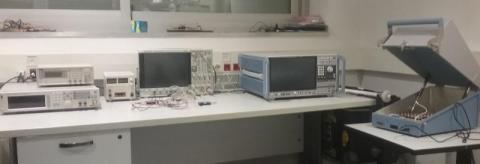
Area A Lab: Fundamental Technologies. A lab specializing in optical technologies for 5G, featuring advanced fiber optics, high- speed systems, and Big Data analytics for network service quality management.

Area B Lab: Communication Systems. A lab for analyzing and optimizing mobile networks (4G/5G), IoT protocols, and radio technologies, with emulators, analyzers, and simulation tools for network planning.

Area C Lab: Networks and Services. Focused on IoT wireless solutions, this lab features advanced testing equipment and an IoT testbed, plus a high-performance platform with OpenStack, SDN-NFV, and slicing frameworks.

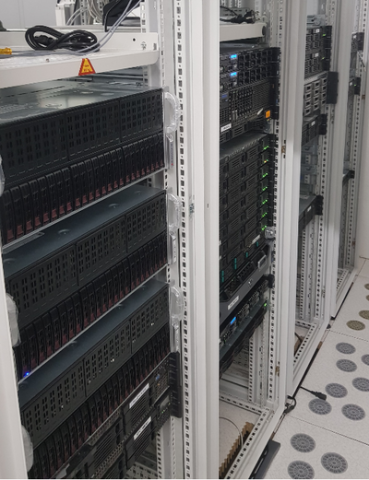
Experimental B5G / 6G Networks: The 6G Labnet UPC infrastructure, developed through the 6G OpenLab and ELEGANT projects led by UPC, aims to revolutionize connectivity with the deployment of an advanced 5G infrastructure towards 6G. This setup constitutes a large-scale testbed for designing, validating, and monitoring components, services, applications, AI tools, and 5G/6G technology protocols. The network is end-to-end multi-technology, including 5G/6G radio access, FR1 and millimeter-wave bands, FR2, Wi-Fi6, WDM, TSN, MEC, and geo-redundant 5G cores. It is equipped with data centers with AI/ML capabilities, measurement equipment, and simulators/emulators, and connects UPC’s Castelldefels and North campuses via a WDM optical network of more than 25 km.

Contracts for Big Science facilities

No registered contracts

Relevant R&D projects

[Horizon Europe - Marie Skłodowska-Curie] GENerative and connected intelligence for 6G Open ManagemEnt (GENOME ) (2026)
GENerative and connected intelligence for 6G Open ManagemEnt (GENOME) research and training programme aims at investigating, developing/fine-tuning and validating large language models (LLMs) for the autonomous management and orchestration of various network technological domains (O-RAN, edge, cloud) through intent-based networking and task-agnostic network functions. It also targets the establishment of a connected intelligence framework for the coordination between these functions via on-the-fly protocol learning to mitigate conflicting management decisions and maximize utilization. Network configuration will also be generated automatically through innovative neuro-symbolic AI algorithms. Moreover, the transparency and resilience of the AI models is researched. All the developed components will be validated via both simulation and testbed experiments, and integrated into a final proof-of-concept. Besides, a detailed training plan is designed including schools, industrial days and soft-skills courses. It involves industrial partners to ensure that career perspectives of ESRs will be significantly increased by participation in the project. High quality dissemination and exploitation activities are also considered.
Next generation high-speed optical networks for metro access (NESTOR ) (2024)
Objective Connectivity is the major driver in the modern “information society”, where the range of data-driven applications is exploding, and new information-based value chains are rapidly emerging. Optical networks are the backbone of the global communication infrastructure, interconnecting billions of people and a huge number of various autonomous devices, control systems, and machines. Optical systems’ development incites the skyrocketing growth in the demand for data exchange and harnessing, fuelled by web-based services such as ultra-HD streaming, cloud services, 5G proliferation, fostering the changes in the digital world, and shaping the structure of the modern society. The demand growth is especially pronounced in the access and metro links, where data rates largely exceeding the current <1 Tb/s will be required. Moreover, the COVID-19 – with the huge number of people working from home – has intensified the pressure on the optical networks. Also, features such as the financial cost of the system elements, latency, dynamic reconfigurability, and energy consumption gain progressively more importance for the new generation of access and metro networks. The Doctorate Network NESTOR will answer the How? When? and Where? coherent optical transceiver will be deployed in metro-aggregation optical networks to meet the demand for new cost-efficient solutions. NESTOR will also address the Who? by providing advanced training to 10 Fellows - from a new generation of engineers - with PhD projects significantly expanding the flexibility and capacity of access/metro networks. NESTOR will provide Fellows with a uniquely broad education ranging from recent advances in ML&AI to real-world telecom engineering, which will enable them to design and implement high-capacity access and metro networks.
[Horizon Europe - Marie Skłodowska-Curie] AI-Enhanced fibre-Wireless Optical 6G network in support of Connected mobility (6G-EWOC ) (2024 - 2026)
The 6G-EWOC project aims to contribute to the development of future 6G-AI based networks by ending with TRL-4-level developments on critical technologies and devices for expanding the reach of 6G, especially in high mobility scenarios. It is addressing Key Societal Value indicators (KVI) defined by the Work Programme and developing KV enablers such as services for coordination, precise positioning and localization, multi-agent supporting network architecture and joint communication and sensing. The three ambitions of 6G-EWOC focus on: AMB1, Optical Wireless Communications (OWC) for V2V and high-rate (Gb/s) V2I applications, chip-scale optical beamformers, and developing connected laser/radio detection, ranging, and communication (Lidar/Radar). AMB2, PIC and ASIC for tuneable transmitter and receiver concepts for fiber-based fronthaul supporting 50 Gbps and 100 Gbps per wavelength over DWDM fiber links and SDN-enabled photonic switching. AMB3 focuses on AI-assisted control and orchestration of resources for the multi-band, heterogeneous 6G-EWOC network concept and AI-based applications development for autonomous vehicles. Up to 17 KPIs are expected to be validated at three final demonstrations. In conclusion, 6G-EWOC search to develop an AI-enhanced fibre-wireless optical 6G network in support of connected mobility by creating a new access network for high mobility scenarios and expanding the reach of 6G through the integration of optical and wireless technologies, free space optics, and joint communication and sensing. It is supported by a fast, reconfigurable, highly dynamic, and customizable optical fiber fronthaul infrastructure, minimizing optoelectronic transitions by tuneable and programmable devices and low energy photonic switching of (packet/optical) spectrum and spatial resources, controlled by AI-based SDN. Providing end-to-end connectivity between AI-based edge computation units supporting connected mobility in a fast reconfigurable network architecture.

Big Science Areas