
General information
Universitat Politècnica de Catalunya
-
Research GroupCCABA - Advanced Broadband Communications Center
-
Hosting Organisiation
-
AddressC/ Jordi Girona, 1-3, D5 Building (08034, Barcelona)
-
Contact Info:
-
Emailsct.rdi@upc.edu
Description
The Centre de Comunicacions Avançades de Banda Ampla (CCABA) is the Universitat Politècnica de Catalunya (UPC)’s reference center for research and innovation in 5G and Beyond communication systems. Its activities were launched in January 1994 with the goal of integrating several UPC research groups working in the field of broadband communications.
CCABA’s areas of interest cover a broad range of technologies related to communications systems, including transmission technologies, cable networks, fiber optics and radio support, switching and interconnectivity, telecommunications network management, as well as protocols and services.
In recent years, the center has incorporated new emerging technologies developed under the concept of Next Generation of Communications Networks and Services (NGNS), such as 5G and beyond, Internet of Things (IoT), virtualization of networks and services, artificial intelligence, augmented reality, machine learning, and smart cities.
Summary of Research Services
The evolution of Next Generation of Communications Networks and Services has progressively influenced the structure and research lines of CCABA, shifting its focus toward the design, integration, and validation of Artificial Intelligence-based platforms for end-to-end 5G and Beyond smart networks and services.
Within this context, CCABA leads the participation of UPC in the 5G-BCN Consortium and is currently involved in several research projects related to 6G technologies, contributing to the development and validation of advanced communication infrastructures and services.
Technology Capabilities
The Centre de Comunicacions Avançades de Banda Ampla (CCABA) at the Universitat Politècnica de Catalunya provides technological capabilities for the design, integration, and validation of next-generation communication networks, with a focus on 5G, Beyond 5G, and emerging 6G technologies.
Its expertise includes optical communication systems, high-speed transmission technologies, and data-driven network quality management, as well as the analysis and optimization of mobile networks (4G/5G), radio technologies, and IoT communication protocols.
CCABA also develops virtualized and software-defined network architectures (SDN/NFV), network slicing, and cloud-based network services, supporting the testing and validation of end-to-end multi-technology communication infrastructures integrating radio, optical transport, edge computing, and AI/ML-based network management.
Main equipment or Facilities
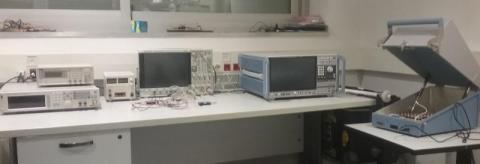
Area A Lab: Fundamental Technologies. A lab specializing in optical technologies for 5G, featuring advanced fiber optics, high- speed systems, and Big Data analytics for network service quality management.
Area B Lab: Communication Systems. A lab for analyzing and optimizing mobile networks (4G/5G), IoT protocols, and radio technologies, with emulators, analyzers, and simulation tools for network planning.
Area C Lab: Networks and Services. Focused on IoT wireless solutions, this lab features advanced testing equipment and an IoT testbed, plus a high-performance platform with OpenStack, SDN-NFV, and slicing frameworks.
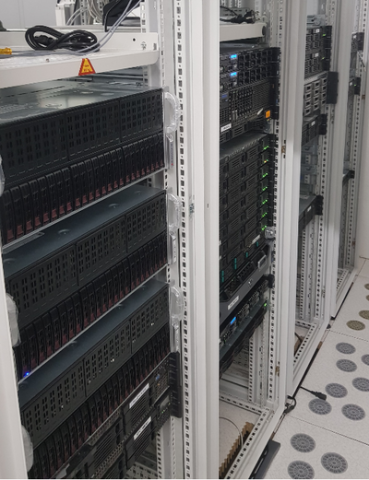
Experimental B5G / 6G Networks: The 6G Labnet UPC infrastructure, developed through the 6G OpenLab and ELEGANT projects led by UPC, aims to revolutionize connectivity with the deployment of an advanced 5G infrastructure towards 6G. This setup constitutes a large-scale testbed for designing, validating, and monitoring components, services, applications, AI tools, and 5G/6G technology protocols. The network is end-to-end multi-technology, including 5G/6G radio access, FR1 and millimeter-wave bands, FR2, Wi-Fi6, WDM, TSN, MEC, and geo-redundant 5G cores. It is equipped with data centers with AI/ML capabilities, measurement equipment, and simulators/emulators, and connects UPC’s Castelldefels and North campuses via a WDM optical network of more than 25 km.