General information
Universidad Politécnica de Madrid
-
Research GroupMaterials for Extreme Conditions and Biomaterials Group
-
Hosting Organisiation
-
AddressETSI de Caminos, Canales y Puertos, C/ Profesor Aranguren 3, 28040 Madrid, Spain.
-
Contact Info:
-
Phone
-
Emailinfo.cime@upm.es
Description
We are an interdisciplinary group working on the edge of new advanced materials for energy at extreme conditions and biomaterials: from the micro to the macro mechanical properties, microstructural and fractographical characterization, from 77 to 2000 K in air and a vacuum, with mechanical testing capabilities to perform in situ tests at high-temperature observation of the deformation and fracture process by SEM, EBDS and EDX, and to develop new complex mechanical testing to cover almost any mechanical testing condition.
Our research lines cover materials as diverse as metals, ceramics, polymers, biomaterials, or functional materials, among others, which has led us to collaborate with more than twenty internationally renowned research centers.
Summary of Research Services
Composite materials
Safety materials
Structural biomaterials
Structural integrity and safety
Construction materials
Nanomaterials
Technology Capabilities
Energy Efficiency
ICT for Healthcare
Main equipment or Facilities
Optical microscopy and atomic forces laboratory.
SEM and FESEM with EBSD, EDX, in situ observation of the microstructure's evolution up to 1500 K, and in situ observation of micromechanical test up to 1100 K.
High temperature chambers for thermal treatments in any material.
DSC and TMA working from 120 to 850 K.
Cryogenic chamber for mechanical testing up to 77.
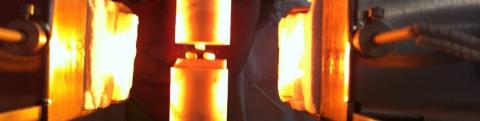
Mechanical testing chamber for high temperature up to 2100 K.
Tribological and wear machine for material testing from 77 to 1300 K in air and reductive atmosphere. Loads available from mN to 200 N.
High-resolution contact profilometer.
> 16 mechanical testing machines for static and dynamic tests with load cells with capacity from 1 mN to 3 MN for any test in any material.
> 50 contact extensometers from 4 K up to 1500 K for any test in any material.
Advanced non-contact extensometers for extreme conditions: laser, video, speckle, etc.
Indentation and instrumented nanoindentation.