

General information
Universidad de Alcalá
-
Research GroupSpace Weather Group (SWE)
-
Hosting Organisiation
-
AddressCampus Universitario, Edificio de Ciencias. Carretera Madrid-Barcelona km 33,600 28805 Alcalá de Henares (Madrid)
-
Contact Info:
-
Phone
-
Emailswe@uah.es
Description
The Space Weather (SWE) group focuses on understanding the Sun–Earth connection and developing advanced solutions to protect technological infrastructures, strengthening society’s resilience against solar activity. We combine observations, numerical models, and artificial intelligence to predict solar phenomena and their terrestrial impacts. Our own monitoring infrastructure enables real-time data acquisition, immediate processing, and the delivery of reliable space weather services.
Our team brings together experts from diverse backgrounds: physicists (covering all stages from the Sun to the Earth), engineers, and artificial intelligence specialists. This multidisciplinary synergy allows us to integrate physical knowledge, advanced modeling, data-driven insights, and engineering innovation to address the scientific and operational challenges of space weather.
SWE has been officially recognized by the University of Alcalá as a High-Performance Research Group, a distinction awarded to teams with outstanding scientific excellence and impact.
Summary of Research Services
We provide a complete chain of operational observation and forecasting products, covering the entire Sun–Earth system. Our services integrate proprietary data with information from space agencies and international organizations to deliver accurate and timely space weather insights.
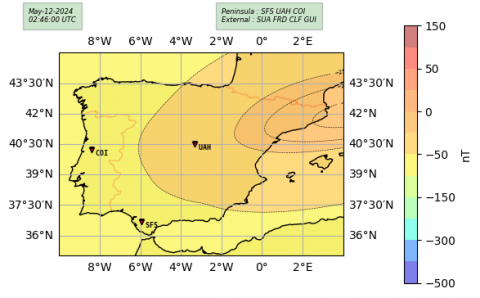
Through the Spanish Space Weather Service (SeNMEs, www.senmes.es), SWE offers nowcasting and forecasting along the full Sun–Earth chain. We are also the first Spanish expert group participating in the ESA Space Weather Service Network (https://swe.ssa.esa.int/), where we contribute specialized products such as regional geomagnetic disturbance maps for the Iberian Peninsula, warnings of adverse space weather conditions, and short-term forecasts of geomagnetic indices using artificial intelligence.
In addition, we provide consulting services for companies and institutions on any space weather-related activity, including forensic analysis of events.
Technology Capabilities
The SWE group combines advanced tools, infrastructure, and expertise to deliver cutting-edge space weather services and research aimed at building a resilient society. Our technological capabilities span the entire Sun–Earth chain, integrating observation, modeling, and artificial intelligence.
A key technological achievement of the group is a patented method (European Patent 3 441 794 B1) for calculating local geomagnetic disturbances in real time. This innovation enables the generation of Local Disturbance Index (LDi) maps with high spatial and temporal resolution. We have also developed the LDi-meter, a dedicated instrument created in collaboration with GMV, which can be deployed at any location to monitor local magnetic conditions.
We operate a GNSS monitoring station to assess the performance of satellite navigation services and analyze ionospheric effects on signal integrity. Our radio telescope detects solar radio bursts that can interfere with GNSS and air traffic control radars. Additionally, we use a custom-built VLF antenna to monitor ionospheric conditions during solar flares.
Leveraging AI, we predict fast solar wind streams and track solar filaments as drivers of geomagnetic storms, while running neural network models for real-time forecasting of global geomagnetic indices up to six hours ahead and local disturbance conditions up to two hours in advance. Some of these capabilities are already integrated into operational services such as the Spanish Space Weather Service (SeNMEs) and the ESA Space Weather Service Network (ESA SWE Portal).
Main equipment or Facilities
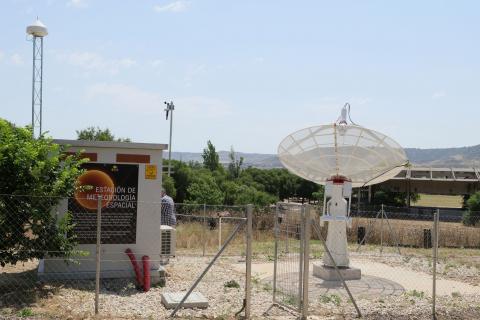
The SWE group manages a comprehensive set of instruments at the UAH Space Weather Station, including:
• Spider 300A radio telescope (3 m antenna) for solar radio burst observation at 1.420 GHz.
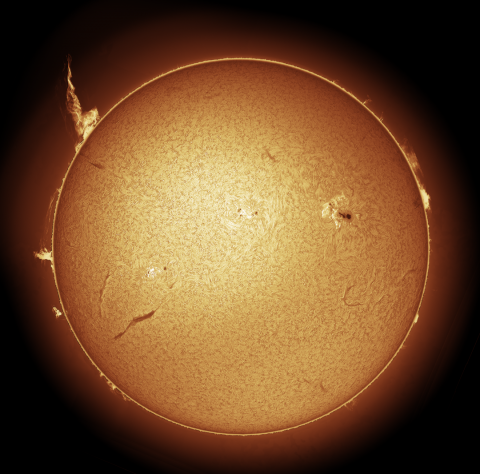
• Lunt 152 mm H-alpha solar telescope for monitoring solar activity.
• GNSS and VLF antennas for ionospheric and navigation signal analysis.
• Magnetic station equipped with a LEMI-031 fluxgate magnetometer and a prototype LDi-meter for local geomagnetic disturbance monitoring.
Our computational infrastructure includes multiple scientific workstations, two high-performance computers with RTX3090 GPUs for neural network training, and a dedicated server with 256 cores, 1 TB RAM, and 40 TB storage for large-scale data processing.