
CommSensLab - Remote Sensing Laboratory
COMMSENSLAB Logo
Imagen
COMMSENSLAB Image 1
1
Pic legend 1: COMMSENSLAB Image 1

General information

Universitat Politècnica de Catalunya

Description

CommSensLab-UPC is a Research Center in Communication and Sensing and a former Maria de Maeztu Unit of Excellence (2017-2020). It integrates the expertise of the AntennaLab, RSlab, and RF&MW research groups to lead research and training in electromagnetic engineering. Its activities cover computational electromagnetics, device and material characterization, and the design of complex systems and algorithms for data analysis across a frequency range from MHz to the optical and THz spectrum. The center focuses on applications in communications, medicine, biosensors, and remote sensing.

Summary of Research Services

The center provides comprehensive services in the conception, simulation, and integration of remote sensing and communication systems, as well as the exploitation of their data. This includes:

• Sensor Integration: Data fusion from multiple sensors for multi-scale environmental characterization.
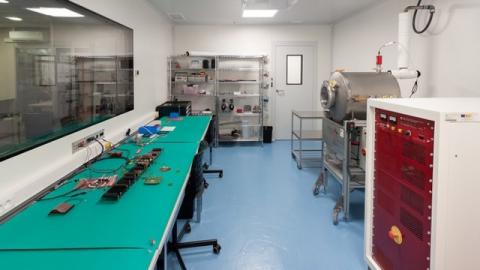
• Environmental Qualification: Environmental testing (vibration, vacuum, and thermal cycling) in a Class 8 cleanroom environment.
• Satellite Engineering: Design and fabrication of satellite systems, including antennas, high-efficiency power supplies, and mission analysis.
• Embedded Systems: Development of software and hardware for small platforms like UAVs, Nano-satellites, and IoT devices.

Technology Capabilities

The group activities cover, among other items, the design and manufacture of satellite systems that include: antennas, communication systems, implementation of communication protocols, collecting and managing solar energy, high efficiency power supply, software engineering and programming, computers and fixed microcontrollers, satellite, payloads, design methods for reliable, verifiable systems, and the mission’s principles of analysis.

Main equipment or Facilities

• NanoSat Lab: A specialized facility within the TSC Department designed for integrating payloads, subsystems, and CubeSats of up to 6 units.
• Antennalab: The chamber is operative from 1 GHz to 40 GHz and has dimensions of 8 x 8 x 10 m3. Since 1980, the work of the Antenna Lab has led to 102 international publications in indexed journals, 208 conference papers and 35 doctoral theses.
• Optical Remote Sensing Group (ORS): As part of Remote Sensing Laboratory, is a research line of the CommSensLab Group at the Universitat Politecnica de Catalunya. Major research work is carried out on elastic, Raman and polarimetric Light Detection and Ranging LIDAR measurements, also the ORS group takes part in some international projects and initiatives as ACTRIS, MPLNET, ChArMEx or ITaRS and colaborates with different institutions as UMASS MIRSL or NASA.
• Passive Microwave Remote Sensing: As part of Remote Sensing Laboratory, is a research line of the CommSensLab Group at the Universitat Politecnica de Catalunya. Major research work is carried out on Instrumentation (Microwave Radiometer, Synthetic Aperture Interferometric Radiometer, GNSS-Reflectometer, etc.), Geophysical data retrieval, RFI detection/mitigation.
• Class 8 Cleanroom: A controlled environment for the assembly and environmental testing of small satellites.
• Vibration table: For mechanical qualification and vibration testing.
• Vacuum chamber: For vacuum and thermal cycling qualification.
• Attitude Control Testbed: Features Helmholtz coils and an air bearing for developing and testing satellite attitude control systems.
• Satellite Tracking Station: Ground station operating in VHF-UHF and S-bands, located at the Montsec Observatory for mission communications and tracking.

Contracts for Big Science facilities

No registered contracts

Relevant R&D projects

SoOp EXtended Observations for DOwnstream Applications UPC (EXODO ) (2025)
EXODO represents a groundbreaking approach to Earth observation, leveraging the transformative potential of signals of opportunity (SoOp) to revolutionize scientific and technological capabilities. The project's core hypothesis posits that integrating multiple remote sensing techniques can create more comprehensive and precise Earth observation systems, offering a cost-effective pathway to address critical scientific and societal challenges, and bridge critical gaps in our scientific understanding. The project strategically develops and integrates cutting-edge remote sensing technologies, including GNSS Reflectometry (GNSS-R), GNSS Radio Occultations (GNSS-RO), Synthetic Aperture Radar (SAR), Doppler lidar and radar, and novel distributed GNSS-R sensors, advanced GNSS-R imaging capabilities combines, wideband microwave radiometers, and polarimetric multispectral imagery. EXODOs strategic objectives are structured around three fundamental General Objectives: - Support Current and Planned Missions: Contribute with leadership and expertise to ESA and non-ESA GNSS and SoOp missions, - Develop High-Impact Scientific Products: Create innovative applications with significant environmental and societal implications, and - Prototype Next-Generation Observation Concepts to maintain the international leadership by pioneering breakthrough Earth observation technologies, and six Specific Objectives targeting diverse scientific and civil applications: ocean and cryosphere, land (soil moisture and vegetation), troposphere and ionosphere to find proxies of earthquakes, renewable energies, precipitation and marine litter monitoring, development of future technology and instruments, as well as advanced processing algorithms.
Artificial Intelligence for Earth Observation (AI4EO ) (2024 - 2025)
Space technologies are collectively known as the three sisters: satellite communications (SatComm), global navigation satellite systems (GNSS) and satellite remote sensing (RS) for Earth Observation (EO). According to the European Union Agency for the Space Programme (EUSPA), the global market for SatCom services is estimated to reach EUR 126 billion by 2025, the global GNSS market is 260 billion in 2023, whereas the EO global revenues are expected to grow from €3.4 billion in 2023 to almost €6 billion in 2033. Hence, the satellite EO market presents a huge economic growth potential. For the private sector to participate in this growth, it is mandatory to acquire and to exploit the scientific and technical knowledge that nowadays is mainly concentrated in universities and research institutions worldwide. EO has seen an explosion of data availability in the last decade due to the increase in space missions, but particularly to the availability of open-access data, which is best exemplified by the policy adopted by the European Space Agency (ESA) and the European Commission (EC) with the Sentinel mission and the Copernicus programme. Nevertheless, the exploitation of the large EO dataset is only possible through the use of a new generation of processing technologies based on Artificial Intelligence (AI), which has undergone significant growth across various societal, economic, and scientific domains over the last decade. In the realm of RS for EO, the use of AI and Machine Learning (ML) models has a historical foundation spanning several decades, albeit under different names and without the current popularity. Despite the present abundance of applications and voluminous datasets, the incorporation of AI in the EO field, notably through Deep Learning (DL), is a relatively recent development and lacks a well-defined framework to extract actionable insights from this data.
Enabling Virtualized Wireless and Optical Coexistence for 5G and Beyond (EWOC ) (2022)
Efficient optical and wireless convergence for (beyond) 5G networks The exponential growth in the use of bandwidth-hungry internet services requires new advances in optical data transmission technologies to achieve ultrahigh throughputs and minimal latencies. 5G systems – a combination of innovative radio and core network technologies – will integrate optical communications. Using an optical core to route 5G data raises significant questions about how wireless and optical technologies can coexist to provide smooth, end-to-end communication pathways. Funded by the Marie Sklodowska-Curie Actions programme, the EWOC project plans to develop a new converged optical wireless network solution, based on flexible and virtualised infrastructure, for the complete optimisation of resources for beyond 5G requirements. EWOC will target high-capacity, low-latency communications (40-90 GHz), providing the basis for a 50-fold improvement in spectral efficiency. Objective EWOC project aims at developing a novel converged optical wireless network solution relying on a flexible, virtualizable infrastructure, required for full resource optimisation beyond 5G (B5G) requirements. Fundamental innovation will be sought through merging of the enabling concepts of optical layer virtualization, high frequency mm-wave transmission, multiple antenna technology, cell densification, terra-over-fiber (ToF) based femtocell connectivity and cloud radio access network (C- RAN) architecture. EWOC will aim at high capacity, low latency communications (40-90 GHz frequency), providing the basis for a 50-fold improvement over the 5G baseline. This necessitates development of novel, femto-cell technology, and seamless coexistence with first round legacy deployment. Such scenario also requires novel channel models and simulation methodologies to attain the desired trade-off between coverage, throughput and densification limits.

Big Science Areas