
General information
Universitat Politècnica de Catalunya
-
Research GroupCCEM - Barcelona Research Center in Multiscale Science and Engineering
-
Hosting Organisiation
-
AddressAv. Eduard Maristany, 10-14, I Building (08019, Barcelona)
-
Contact Info:
-
Phone
-
Emailsct.rdi@upc.edu
Description
The Barcelona Research Center in Multiscale Science and Engineering (CCEM Barcelona) is a multidisciplinary hub at the forefront of materials science, in the fields of micro and nanoengineering, nanotechnology and biomaterials.
Our center, former Centre de Recerca en Nanoenginyeria (2009), was established in 2016 to promote collaboration between research groups and highlight their research excellence internationally. It is located in Campus Diagonal-Besòs, in Barcelona, and is part of the Universitat Politècnica de Catalunya (UPC).
We do cutting-edge research to develop innovative technologies with the aim of contributing to solve current and future challenges. Our focus is on crafting solutions for Health, Energy and the Environment. By developing the materials of the future, we envision a better, more sustainable world.
The Barcelona Research Center in Multiscale Science and Engineering is an international center, with members from all over the world. It hosts 8 research groups in the field of materials science, with more than 250 researchers, including PhD students, Postdocs and other staff.
In 2024, the CCEM Barcelona received the María de Maeztu Unit of Excellence accreditation (CEX 2023-001300-M/AEI/10.13039/501100011033) funded by the Spanish State Research Agency, as recognition of a history of effort and success.
Summary of Research Services
Research at the CCEM focuses on three scientific basic and applied pillars: health, energy and environment.
The main objectives of the infrastructure are to develop research in the following fields:
• Nanoparticle manipulation and study for electronic, communication and sensor applications.
• Mechanical, electrical and electronic properties of micro- and nanodevices, structures and biological systems.
• Multiscale analysis of coupled processes: complex system behavior.
• Nanoscale analysis of surfaces and reactivity.
• Simulation and modelling of nanometric systems and nanostructured materials.
• Manufacture, characterization and applications of micro- and nanometric layers.
• Integration of nanoscale devices in micro- and mesoscopy systems.
• Design, preparation and characterization of nanoparticles and their use in catalysis.
• Energy and environmental applications of nanoparticles and nanostructures in general.
Technology Capabilities
Main research topics include:
• Manipulation and study of nanoparticles for applications in electronics, communications and sensors.
• Mechanical, electrical and electronic properties of micro- and nanodevices, structures and biological systems.
• Multiscale analysis of coupled processes: Complex system behaviour.
• Nanoscale analysis of surfaces and reactivity.
• Simulation and modelling of nanometric systems and nanostructured materials.
• Fabrication, characterization and applications of micro and nanometric layers.
• Nanometric devices integration in micro and mesoscopic systems.
• Design, preparation, and characterization of nanoparticles and their use in catalysis.
• Energy and environmental applications of nanoparticles and nanostructures.
Main equipment or Facilities
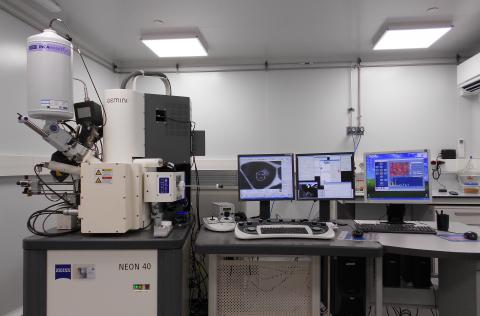
• Focused Ion Beam. Neon40 Crossbeam™ Workstation
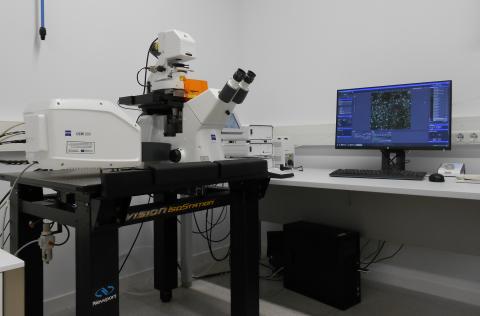
• Scanning Electron Microscope (SEM)
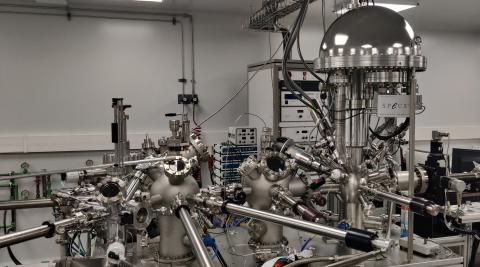
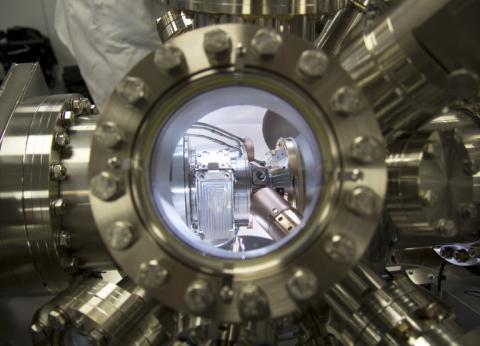
• X-ray photoelectron spectroscopy SPECS
• X-ray diffraction D8 Advance
• Near-ambient pressure X-ray photoelectron spectroscopy PECS
• Inductively Coupled Plasma Optical Emission Spectrometry
• Inductively Coupled Plasma Mass Spectrometry (ICP-MS)
• NMR Bruker Ascend 400 of 400 MHz
• Atomic Force Microscopy (AFM)
• Raman spectroscopy
• Infrared spectroscopy (FTIR)
• UV-visible absorption spectroscopy (UV-vis)
• Circular dichroism spectroscopy (CD)