
General information
Universidad Politécnica de Madrid
-
Research GroupInstrumentation and Applied Acoustic Research Group (i2a2)
-
Hosting Organisiation
-
AddressC. Mercator, 3, Puente de Vallecas, 28038 Madrid
-
Contact Info:
-
Phone
-
Emailinfo@i2a2.upm.es
Description
The UPM-I2A2 research group has more than 15 years of experience researching and developing data acquisition and high throughput processing applications using PXI/PXIe and interlock solutions with cRIO form factor. In particular, the research group started its work in this field in 2001-year developing advanced DAQ solutions for the fusion community in collaboration with CIEMAT and Joint European Torus for different projects related to machine learning applications. Since 2010 I2A2 is a strong collaborator of ITER CODAC in the field interlock solutions and advanced data acquisition and processing applications for ITER fast controller using FPGA-based DAQ devices. I2A2 has an extensive experience integrating hardware and software for CODAC applications.
Summary of Research Services
Acoustic Metrology
Audio Signal Processing
Electroacoustic
Environmental Noise
Industrial Noise
Room acoustics
Virtual instrumentation
Technology Capabilities
Advanced data acquisition and processing systems
Integration in EPICS
Advanced heterogeneous platform
fpga-based daq applications
Main equipment or Facilities
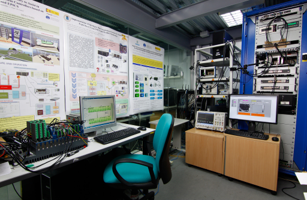
The UPM-I2A2 research group has dedicated facilities for the development of advanced instrumentation systems using most common industrial form factors such as MTCA, PXIe and cRIO. There is a specific area with Instrumentation and Control cubicles with industrial computers running ITER CODAC Core System, connected to MTCA , PXIe, and cRIO systems. These systems have high-speed data acquisition devices using XILINX and IntelFPGA devices with different I/O modules for signal and image processing.
I2A2 has all the software tools to develop applications for Artificial Intelligent and Machine learning in the Edge solutions applied to big science applications.
I2A2 is also an expert in the integration of hardware in EPICS. The infrastructure for software development is completed with all agile solutions using JIRA, and STASH.
Software, tools or licenses to be applied to Big Science
Integration of advanced data acquisition systems in EPICS using open source tools.
Nominal Device Support for ITER CODAC.
Development of on the edge Artificial Intelligent solutions for big science applications using IntelFPGA-OpenCL SDK and XILINX-Vitis.
Development and integration of embedded platforms using ACAPs, SoCs, and FPGA.