
General information
Universidad Politécnica de Madrid
-
Research GroupInstitute for Nuclear Fusion “Guillermo Velarde”
-
Hosting Organisiation
-
AddressEscuela Técnica Superior de Ingenieros Industriales (ETSII). C/ José Gutiérrez Abascal, 228006 Madrid, España
-
Contact Info:
-
Phone
-
Emailifn-gv@industriales.upm.es
Description
Official Research Institute of the Madrid Government, in the frame of UPM, since 1982 (BOE nº 73/26-3-1982) as Advisor to Presidency of Government in all Nuclear Affairs. It has groups in three Universities: UPM, UNED and ULPGC. It has been and is mainly devoted to Inertial Confinement Fusion research as energy source in areas of laser-ion interaction with plasma, target design and manufacturing; ICF reactors design including neutronics and safety processes; Materials under irradiation. In addition, it has been a very active collaborator in EU Fusion Technology in general, ITER in particular through its group in UNED University. Partitioning and Transmutation by Accelerator Driven Systems and Neutron (Radiation) Sources based in Spallation has been also part of its research. It is composed by 30 Professors, 7 Post-Docs, 1 Specially Ministry granted “Beatriz Galindo” Guest Professor, 15 PhD Students and 15 engineers under contract with European Spallation Source (ESS) in Bilbao.
Summary of Research Services
FUSION TECHNOLOGY FOR LASER AND MAGNETIC FUSION
INERTIAL FUSION, DESIGN OF LASER FUSION REACTORS,
RADIOACTIVE WASTE TRANSMUTATION, ACCELERATOR-DRIVEN SYSTEM,
ADVANCED FISSION REACTORS AND SPALLATION NEUTRON SOURCES
VERY INTENSE LIGHT SOURCES
Technology Capabilities
Laser Fusion, X-rays lasers, Astrophysics, Radiation-Hydrodynamics
Atomic Physics, Shock Waves
Nanostructural Materials
NANOPLASMONIC. Trapping of He by Hollow W nanoparticle
3D Neutronics; large structures. ITER design Particle transport
Intense Radiation Sources: collaboration on Target from ESS-Bilbao
Main equipment or Facilities
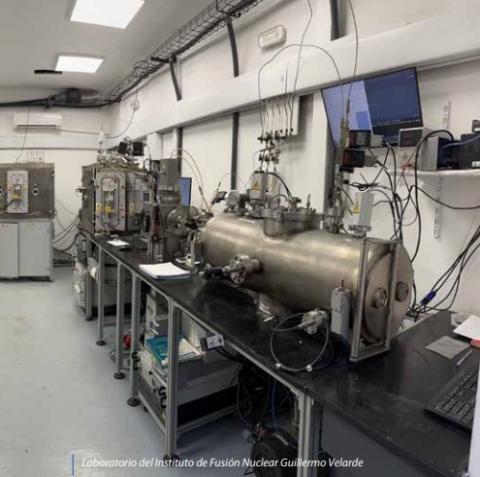
Laboratory focused on Resistant materials to extreme conditions (irradiation, corrosion, thermal load, abrasion).
Development, characterization and modeling before and after the extreme treatment of:
Nanostructured coatings of tungsteno.
Carbon Nanotubes.
Graphene Foam.
Diamond-like Carbon.
Plasmonic particles.
The facilities allow:
Manufacturing by sputtering at different scales.
Study of gases with permeation equipment and thermal desorption spectroscopy.
In situ optical measurements during radiation experiments.
Software, tools or licenses to be applied to Big Science
MCUNED, ACAB, R2UNED: 3D neutron-gamma-ions transport and activation with uncertainties.
ARWEN: 2D AMR radiation-hydrodynamics.
MDCASK: molecular dynamics code.
MMONCA: kinetic Montecarlo diffusioncode.
Atomic Physics codes for EOS and opacities