
General information
Universidad Politécnica de Madrid
-
Research GroupSolar Energy Institute
-
Hosting Organisiation
-
AddressETSI Telecomunicación Avenida Complutense, 30 Ciudad Universitaria 28040 Madrid (SPAIN)
-
Contact Info:
-
Phone
-
Emailies@upm.es
Description
The Solar Energy Institute is the oldest research institute of the Universidad Politécnica de Madrid –founded back in 1979– and it is a worldwide renown research center in the field of Renewable Energies. We are a center fully focused on the photovoltaic conversion of light into electricity, covering all aspects in the value chain. We do materials science around photovoltaic materials; we devise, manufacture, measure and simulate solar cells to improve their performance and produce more cost effective devices; we search for solutions to the challenges that PV technology is facing, all the way from the source material to utility scale solar installations, including the characterization of multi-MW plants, the application of PV in novel fields or the development of more efficient strategies for demand-side management or the use of batteries to ease PV integration into the electricity grid.
Summary of Research Services
Solar cells and materials
Advanced characterization
Solar radiation and solar simulators
Modelling and simulation
Field test and quality of PV systems
Building Integrated Photovoltaics (BIPV) for new buildings and renovation projects
Positive Energy Districts and urban energy transition
Technology Capabilities
Advanced Solar Cell Technologies
Device Processing and Micro-Fabrication
Diagnostics and Characterization Facilities
System Integration and Grid Analysis
Main equipment or Facilities
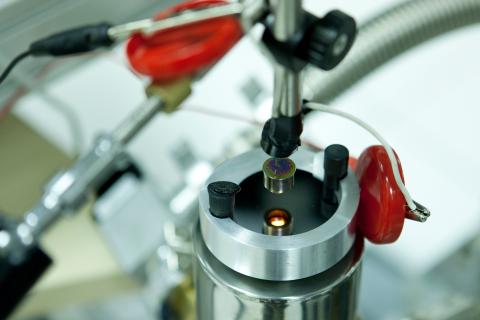
The Solar Energy Institute is equipped with state-of-the-art facilities for Photovoltaic research distributed along their three sites in Madrid. We have a fully operational lab-scale solar cell production line where different materials can be manufactured and measured, then processed into solar cells and characterized to assess their efficiency to be finally submitted to accelerated ageing tests in climatic chambers to evaluate their lifetime. We have solar simulators and outdoor test facilities for the measurements of solar modules of diverse technologies. We have a solar home where PV building integration, demand-side management and smart-grid technologies can be put to the test.
We have portable systems for the field measurement of multi-MW utility scale photovoltaic power plants. In short, we are home to most pieces of equipment needed to understand and improve PV materials, cells, modules and power plants.
Software, tools or licenses to be applied to Big Science:
At the Solar Energy Institute we work with a broad set of software tools for the modelling and simulation of different photovoltaic problems. From solar spectra to photovoltaic materials; from new solar cells to state-of-the-art photovoltaic panels, arrays or plants , we can model their performance under different conditions.
Most of such are home-made pieces of code built and expanded along years of dedicated research.
Commercial tools as SILVACO ATLAS, LightTools, PVSyst are also available.